
Preparing New HDB BTO Estates for Move-In: The Complete 2026 Window Grille, HDB Safety Regulations & Design Guide
August 12, 2026
The 2026 AVS & HDB Cat Management Framework: Legal Requirements & Home Safety Mandates
The landscape of Singapore public housing experienced a historic shift when the Animal & Veterinary Service (AVS), operating under the National Parks Board (NParks), launched the official Cat Management Framework alongside the Housing & Development Board (HDB). Reversing a 34-year ban that dated back to 1989, HDB flat owners can now legally keep up to two cats per household. However, this legal freedom comes with strict, non-negotiable statutory responsibilities designed to protect animal welfare and maintain urban harmony in high-density residential blocks.
The two-year transitional allowance period concludes on 31 August 2026. After this deadline, keeping an unlicensed cat or failing to comply with mandatory physical housing safety requirements becomes a strict liability offence under the Animals and Birds Act. While pet microchipping and taking the free online AVS Pet Ownership Course handle the administrative side of compliance, the primary physical condition for licensing focuses directly on your home interior: flat owners must secure their windows, balconies, service yards, and main entrance gates to prevent cats from falling from height or roaming into common corridors.
High-Rise Syndrome is a constant threat across high-rise estates from Punggol BTO developments to mature resale flats in Toa Payoh. Cats possess an instinctive prey drive that causes them to leap after birds, insects, or drifting debris. On slippery powder-coated window ledges 15 stories above ground, a single misstep leads to catastrophic or fatal injuries. The AVS framework mandates that cat owners implement physical barriers capable of containing curious felines safely inside the flat. For Singaporean homeowners, ensuring compliance is not just about passing a spot inspection by AVS or Town Council officers; it is about building an engineered defense system that keeps your pets alive without turning your apartment into a dark, airless cage.
Technical Breakdown of Legal Window Barriers for High-Rise Flats
Complying with the AVS cat-proofing mandate requires understanding structural gap clearances and material strength profiles. Standard HDB window grilles installed purely for child safety or burglary prevention feature vertical bar gaps ranging between 100mm and 120mm (10cm to 12cm). While a 10cm gap effectively stops a human toddler, a juvenile cat or a slender adult feline can easily squeeze its head and flexible ribcage through that space. Once the head clears the gap, the rest of the body follows, resulting in a fall.
To meet legal and safety standards, a window barrier must fulfill three primary mechanical parameters:
- Maximum Gap Spacing: Clear openings between wires, bars, or mesh weaves must not exceed 50mm (5cm). For households with kittens or small breeds like Singapuras or Siamese cats, effective gap clearance should ideally drop below 30mm.
- Shear & Claw Impact Resistance: The barrier material must withstand high localized clawing, biting, and mechanical impact without tearing, fraying, or slipping out of its perimeter track. Standard soft fiber insect mesh is inadequate because sharp cat claws easily tear through vinyl-coated fiberglass within days.
- Anchor Integrity & Track Locking: The overall system must be mechanically anchored into the building’s structural concrete lintel or riveted to existing aluminium window sub-frames. Clip-on solutions that rely on light adhesive tapes or unreinforced suction cups fail when exposed to Singapore’s tropical humidity and heat cycles.
| Protection System Type | Max Gap Clearance | Material / Tensile Grade | Airflow Penetration | AVS Compliance Level | Visual Impact | Est. Investment |
|---|---|---|---|---|---|---|
| High-Tensile Pet Screen Mesh | 1.5mm – 2.0mm | 304 Stainless / PET Mesh | 82% – 88% | Fully Compliant | Near Invisible | Low – Moderate |
| 50mm Invisible Cable Grille | 50mm (5.0cm) | 316 Marine Stainless Cable | 96% – 98% | Fully Compliant | Ultra Minimalist | Moderate – High |
| Custom Aluminium Safety Grille | 30mm – 50mm | T6 Architectural Aluminium | 85% – 90% | Fully Compliant | Visible Bars | Moderate |
| Standard HDB Grille (Legacy) | 100mm – 120mm | Hollow Aluminium / Steel | 92% – 95% | Non-Compliant | Traditional | Legacy Unit |
| Standard Fiberglass Mosquito Net | 1.2mm | Vinyl-Coated Fiberglass | 80% – 85% | High Risk (Tears) | Translucent | Low |
High-Tensile Pet Screens & Magnetic Window Protection Systems
For homeowners who want complete protection against both feline falls and Singapore’s persistent tropical mosquitoes, high-tensile magnetic pet screens offer a sleek dual-purpose solution. However, you must distinguish between standard soft mosquito netting and specialized high-density pet screening systems. Standard fiberglass mesh cannot withstand a cat scaling the screen. Within weeks, sharp claws create frayed tears that widen into escape routes.
Engineered window and door screens designed specifically for pet protection utilize heavy-gauge 304 marine-grade stainless steel wire or ultra-thick polyvinyl-coated polyester yarns (PET mesh). PET pet screen material features a thread diameter up to three times thicker than standard insect netting, boasting a burst strength exceeding 180 psi. This density ensures that even if a 6kg tomcat leaps directly onto the screen after a bird, the weave absorbs the impact without puncturing or sagging.
The mounting mechanism is equally vital. High-grade magnetic pet screen installations utilize neodymium magnetic strips paired with custom extruded PVC or aluminium sub-frames. The outer frame clips tightly into an inner groove that locks the mesh under constant perimeter tension. When retrofitting sliding or casement windows in HDB flats, professional installers affix raw magnetic base tracks to the inner aluminium frame using high-tack industrial acrylic adhesives rated for elevated ambient temperatures up to 90°C. This ensures the frame will not peel off during hot afternoon sun exposure along unblocked west-facing facades in Jurong or Punggol.
Key Advantages of Magnetic Stainless Steel Pet Screens
The primary benefit of installing dedicated stainless steel pet screens lies in complete insect exclusion alongside 100% gap coverage. Because the mesh aperture is under 2mm, even newborn kittens cannot poke their heads through. Furthermore, these systems allow full natural ventilation, allowing cross-winds to cool your flat without forcing you to keep air conditioning running constantly. The screen frames can be unclipped easily for routine washing at the toilet shower tap to clear accumulated dust, keeping household air quality clean.
50mm Narrow-Gap Stainless Steel Invisible Grilles for High-Rise Apartments
For modern HDB BTO owners and condominium residents who want maximum light and uninterrupted views, high-tensile invisible grilles are the gold standard. However, standard child-safety invisible grilles are typically tensioned at 100mm (4-inch) gap intervals. While a 10cm gap keeps young children safely inside, it represents a direct violation of cat safety guidelines. Cats can easily compress their shoulders and slide through a 10cm cable gap.
To establish true cat-proof legal protection, you must specify a custom invisible grill installation engineered with a maximum 50mm (2-inch) gap spacing. In households with active kittens or agile breeds, some installations incorporate horizontal stiffener memory bars or reduce spacing down to 30mm along lower window segments.
Metallurgical & Cable Engineering Specifications
Not all cable wire grilles offer equal strength. For high-rise feline security, the internal construction of the wire core dictates long-term performance under constant tension:
- 316 Marine Grade Stainless Steel Core: Unlike basic 304 grade steel, 316 stainless steel contains 2% to 3% molybdenum, providing exceptional resistance against airborne salt corrosion and high humidity in coastal Singapore locations like East Coast, Marine Parade, and Punggol Waterway.
- Core Construction Matrix: The cable should feature a 7×7 or 7×19 strand structure. A 7×19 structure consists of 7 strands composed of 19 individual micro-wires twisted together. This configuration provides high tensile flexibility alongside a breaking force strength exceeding 120kg to 140kg per individual cable.
- Nylon Membrane Encasement: The steel core must be jacketed with a high-density, UV-stabilized Nylon-12 or Teflon membrane. This protective layer prevents the steel strands from scratching human hands or damaging feline claws during sudden contact, while keeping moisture out to prevent internal cable degradation over time.
- Aluminium Track Anchoring & Tensioning Locks: Cables are held under heavy mechanical tension by high-grade solid brass or stainless locking pins anchored inside extruded structural aluminium tracks. These tracks are bolted directly into the ceiling slab and concrete window ledge using heavy-duty masonry expansion bolts. This guarantees that pushing or pulling on the cables will not spread the 50mm gap apart.
When selecting invisible grilles for HDB casement or sliding window openings, always opt for vertical orientation over horizontal cables. Horizontal cables can act as a natural ladder step if a cat attempts to climb the window wall, whereas vertical cables offer no foothold, encouraging cats to stay grounded on the floor or window sill pad.
Custom Aluminium & Heavy-Duty Safety Grilles for Permanent Feline Security
Homeowners who prefer traditional solid physical barriers over steel wire systems can opt for custom aluminum window grilles designed specifically with narrow gap profiles. Standard off-the-shelf aluminium grilles supplied in older resale flats usually feature horizontal or decorative lattice bars spaced 100mm to 120mm apart. Customizing the frame construction to reduce internal bar spacing down to 30mm or 50mm creates an impenetrable barrier that keeps cats safe without sacrificing structural strength.
Opting for a targeted safety grilles installation allows flat owners to integrate specialized hardware locks, key-operated latches, and custom swing-open mechanisms. Swing-open designs are particularly useful for casement windows, enabling easy access to scrub the outer window glass while ensuring the frame stays securely locked whenever the window is open for ventilation.
Material Grades and Structural Bar Configurations
Engineering a pet-safe aluminium grille requires selecting high-grade materials and choosing the right structural configuration:
- T6 Architectural Aluminium Alloy: High-grade 6063-T6 extruded aluminium offers exceptional resistance to bending and twisting forces. Unlike raw hollow aluminium bars that flex under pressure, T6 grade extrusions retain their form even when subjected to sudden concentrated forces.
- Solid Bar vs. Hollow Tube Profiles: Standard budget grilles use thin-walled hollow tubes that can dent or bend over time. Cat-proof installations utilize solid aluminium rods or thick-walled hollow sections (minimum 1.2mm to 1.5mm wall thickness) to maintain structural gap integrity across wide window spans.
- Powder Coating & Anodized Finishes: Singapore’s humid climate leads to surface oxidation on bare metals. Electrostatic powder coating bonded at 200°C creates a smooth, durable finish that resists claw scratching, prevents rust formation, and makes cleaning accumulated cat fur simple with a damp microfiber cloth.
- Keyed Safety Latches & Double-Action Locks: Smart cats quickly learn to operate simple slide bolts or lift-up catches by batting at them with their paws. Pet-safe installations utilize double-action push-and-twist latches or concealed lock boxes that require human hand dexterity to disengage, preventing accidental opening.
Corridor & Main Gate Proofing: Preventing Escalator & Lift Roaming
Securing your windows handles the high-rise fall hazard, but compliance under the AVS Cat Management Framework also mandates preventing your cats from roaming freely outside your home. Unsupervised cats roaming along HDB common corridors, lift lobbies, and staircase landings frequently trigger neighborhood friction, trailing claw marks on neighbor doorway mats, territorial spraying, or accidental escapes down lift shafts.
Town Councils across Singapore enforce strict anti-roaming by-laws. Leaving your main iron door or wrought aluminium gate wide open without a secondary mesh barrier violates estate management rules and compromises your cat’s safety. When someone opens the door for food delivery riders, postmen, or routine trash disposal, an unblocked gate gives a skittish cat a split-second window to dart into the corridor.
Practical Gate Proofing Solutions
Retrofitting your main entrance gate with pet safety barriers does not require replacing the entire gate assembly. Effective modification options include:
- Lower-Half Solid Polycarbonate Sheets: Mounting a clear 3mm to 4mm thick UV-stabilized solid polycarbonate sheet across the bottom half (up to a height of 1.0m to 1.2m) of your main gate creates an effective jump barrier. The transparent surface preserves visual clarity while preventing cats from squeezing through vertical iron bars or using them as climbing footholds.
- Full-Height Stainless Steel Mesh Inserts: Installing custom-fitted 304 stainless steel wire mesh panels inside the main gate frame provides full-height containment from floor to top transom. Using black powder-coated mesh maintains a clean appearance while allowing natural corridor breeze to flow straight into your living room.
- Magnetic Self-Closing Secondary Mesh Doors: Placing an internal heavy-duty magnetic mesh screen behind the main timber door frame adds an extra buffer zone. When you open the primary wooden door, the inner screen remains magnetically sealed, preventing your cat from rushing past your ankles into the hallway.
AVS Mandatory Compliance Checklist for Singapore HDB Cat Owners:
• Microchipping: Ensure your cat is microchipped by a licensed veterinarian and registered in the AVS Pet Animal Licensing System (PALS).
• Online Education: Complete the mandatory free AVS Pet Ownership Course covering urban pet care, nutrition, and home containment responsibilities.
• Window & Gate Containment: Install physical barriers with gap clearances of 50mm or smaller across all windows, service yards, balconies, and entrance gates to eliminate fall and roaming risks.
• Licensing Registration: Apply for individual cat licenses via the AVS PALS portal prior to the 31 August 2026 transitional deadline to secure lifelong grandfathering status for existing pets.
Step-by-Step Onboarding Checklist for HDB Flat Preparation in 2026
Preparing an HDB apartment for cat licensing requires a systematic approach to identify hidden escape hazards before submitting your registration to AVS. Follow this engineering checklist to ensure complete compliance and safety:
- Step 1: Conduct a Perimeter Gap Clearance Audit
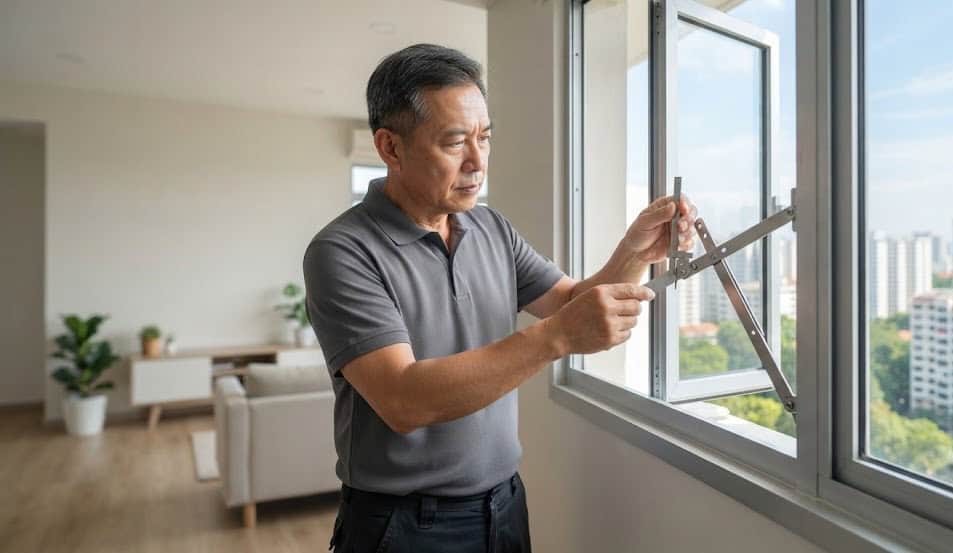
Walk through every room in your flat with a standard measuring tape. Inspect living room casements, bedroom sliding windows, toilet top-hung louver windows, and service yard drying rack openings. Any gap wider than 50mm (5cm) requires immediate mesh or grille installation. - Step 2: Inspect Ledge Heights and Furniture Placement
Cats easily jump up to six times their height. Examine the proximity of sofas, dining chairs, study desks, and cat trees to open windows. Never assume a high window is safe simply because it sits 1.5 meters above the floor; an adjacent cabinet can serve as a jumping platform directly to the window ledge. - Step 3: Evaluate Opening Mechanisms and Latch Security
Check if your existing window handles latch securely. Older aluminium sliding windows often feature loose plastic friction locks that can be pushed open by a persistent cat leaning its weight against the frame. Replace worn latches with key-operated window locks or secondary thumb-turn stoppers. - Step 4: Audit the Service Yard & Kitchen Exhaust Vents
HDB service yards present significant risks because washing machines and clothes drying racks provide easy climbing routes toward open parapet walls. Install full-height 50mm invisible grilles or magnetic pet screens across the entire yard opening to ensure continuous safety while doing laundry. - Step 5: Schedule Professional Measurement & Installation
Engage a certified window grille specialist to take site measurements, verify structural wall anchorage, and install custom-built, code-compliant barriers before finalizing your cat’s microchip and licensing registration.
Frequently Asked Questions Regarding HDB Cat Proofing & Regulations
What happens if I fail to cat-proof my HDB windows before the August 31, 2026 deadline?
Failing to secure your premises to prevent pet falls or roaming violates the conditions of the AVS Cat Management Framework. Flat owners keeping unlicensed cats or failing to maintain physical safety barriers after 31 August 2026 face administrative penalties and composition fines up to $5,000 under the Animals and Birds Act. Repeated non-compliance can lead to license revocation and the removal of unauthorized pets from the premises.
Are standard 100mm (4-inch) invisible grilles legally compliant for HDB cat owners?
No. Standard 100mm cable spacing is designed for human child safety and does not stop cats. Kittens and slim adult cats can easily squeeze their heads through a 10cm opening, leading to falls. To satisfy AVS cat containment requirements, invisible grilles must be installed with maximum cable gaps of 50mm (2 inches) or narrower.
Do I need HDB or Town Council permits to install 50mm invisible grilles or magnetic screens?
Installing internal window grilles, magnetic screens, or invisible grilles inside your flat does not require formal HDB renovation permits, provided the installation does not alter the building’s structural concrete facade or exterior building appearance beyond approved guidelines. However, contractors must adhere to BCA safety installation standards when anchoring frames into structural walls.
Can I install cat-proof barriers in a rented HDB flat without drilling window frames?
Yes. High-tensile magnetic pet screens offer a non-invasive installation method ideal for rented flats. The magnetic base strips adhere directly to existing aluminum window sub-frames using high-tack acrylic adhesives. This setup leaves no drill holes or permanent structural modifications, making frame removal straightforward when vacating the tenancy.
How do I clean fur and dust from 50mm invisible grilles and magnetic screens?
For magnetic pet screens, simply unclip the screen frame from its magnetic track, gently rinse it in the shower using mild detergent, wipe dry with a towel, and snap it back onto the window frame. For 316 stainless steel invisible grilles, wipe the nylon-coated cables vertically using a damp microfiber cloth or a soft vacuum brush attachment to remove airborne dust and trapped cat hair without scuffing the cable membrane.
Ensure Complete Legal Compliance with Professional Cat-Proofing Installation
The legalization of cats in HDB flats marks an exciting milestone for Singapore pet lovers, but meeting the mandatory safety deadline requires proactive home planning. Transitioning your living space into a safe environment demands engineered solutions that keep your feline family members secure without ruining your flat’s aesthetics or airflow.
Whether you choose sleek magnetic pet screens, ultra-clear 50mm marine-grade invisible grilles, or heavy-duty powder-coated aluminium safety grilles, professional installation ensures every gap is measured and anchored to high standards. Avoid taking risks with unverified DIY kits or wide-gap legacy grilles that leave your pets vulnerable to high-rise accidents.
Take the proactive step today to secure your home ahead of the mandatory AVS licensing deadline. Contact our BCA-certified technical installation team to schedule a comprehensive on-site window audit and custom measurement session for your HDB BTO, resale flat, or private apartment. Protect your pets, satisfy legal requirements, and enjoy peace of mind in high-rise living.